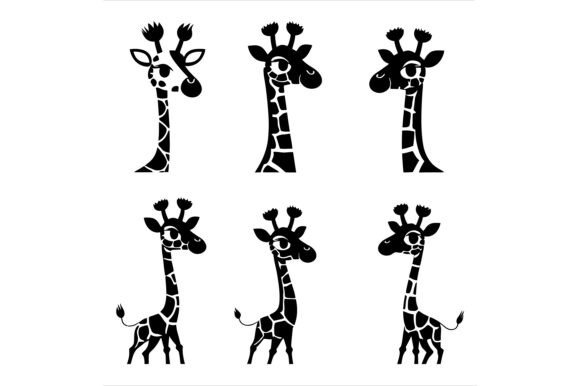
Cartoon Giraffe in Black and White: A Practical Evaluation
In the realm of digital design assets, the Cartoon Giraffe in Black and White represents a specific category of vector illustration that balances simplicity with versatility. This asset is typically provided as a high-quality EPS vector file accompanied by a high-resolution JPEG preview. Unlike photographic images or complex color illustrations, this black-and-white line art focuses on clean outlines and distinct shapes. For designers, crafters, and content creators, understanding the technical specifications and practical applications of this specific graphic is essential before integrating it into a project.
Understanding the Asset Structure
The core value of the Cartoon Giraffe in Black and White lies in its file formats. The primary deliverable is an EPS (Encapsulated PostScript) file. This format is industry-standard for vector graphics, meaning the image is defined by mathematical equations rather than a fixed grid of pixels. Consequently, the illustration can be scaled to any size—from a small business card logo to a large billboard—without any degradation in visual quality. The lines remain crisp, and the edges stay sharp regardless of magnification.
Alongside the editable vector, a JPEG file is often included. While the JPEG serves as a convenient, ready-to-use option for quick previews or low-stakes digital projects, it lacks the scalability of the EPS. It is a raster image, meaning enlarging it beyond its original resolution will result in pixelation. The combination of these two files caters to different workflow needs: the JPEG for speed and the EPS for precision and professional customization.
Why Designers Choose Black and White Line Art
There are several strategic reasons why a creator might select a Cartoon Giraffe in Black and White over a fully colored alternative. The most significant advantage is adaptability. In a monochrome format, the artist retains complete control over the final color palette. Whether the project requires a vintage sepia tone, a vibrant neon scheme, or a corporate brand color, the base illustration remains neutral until the designer applies their own hues.
Furthermore, black and white line art often possesses a timeless aesthetic. It avoids trends associated with specific shading styles or color palettes that may date a design quickly. This neutrality makes it particularly effective for educational materials, where clarity is paramount, or for branding elements that need to stand out against various background textures. The simplicity of the cartoon style also ensures that the subject matter is immediately recognizable, which is crucial for icons, logos, and children's content.
Key Benefits of Vector Formats
- Infinite Scalability: The EPS format ensures the giraffe illustration looks perfect at any dimension, eliminating the risk of blurry images in print.
- Full Editability: Designers can modify individual elements, such as adjusting the thickness of lines, changing the angle of the neck, or altering facial expressions using vector software.
- File Efficiency: Vector files are generally smaller in size compared to high-resolution raster images, making them easier to manage within complex design projects.
- Color Flexibility: Starting with black and white allows for seamless integration into any color scheme without clashing with pre-existing tones.
Ideal Use Cases and Applications
The Cartoon Giraffe in Black and White is a strong fit for a variety of specific scenarios. Its clean lines make it an excellent choice for print-on-demand products, such as t-shirts, mugs, and tote bags. In screen printing, fewer colors reduce production costs, and a black outline can be easily filled with spot colors during the printing process.
For DIY enthusiasts and scrapbookers, this asset offers a printable template that can be cut out with precision. The high contrast between the black lines and white background facilitates easy cutting, whether done manually or with a digital cutter like a Cricut or Silhouette machine. Additionally, the illustration works well for wall art and posters. When printed on textured paper or canvas, the stark black lines create a modern, graphic look that complements minimalist interior design.
In the context of educational materials, this type of illustration is highly effective. Teachers and curriculum developers often require clear, uncluttered images for coloring books, worksheets, and flashcards. The absence of distracting colors allows students to focus on the shape and details of the animal, encouraging creativity through coloring activities.
Considerations and Tradeoffs
While versatile, the Cartoon Giraffe in Black and White is not a universal solution. One primary tradeoff is the requirement for specialized software. To fully utilize the EPS file, the user must have access to vector editing tools such as Adobe Illustrator, CorelDRAW, or open-source alternatives like Inkscape. Without these tools, the user is limited to the static JPEG, which negates the benefits of the vector format.
Another consideration is the level of detail inherent in "cartoon" styles. These illustrations prioritize stylization over realism. If a project demands anatomical accuracy or photorealistic textures, this asset will not meet those expectations. The simplified features, while charming, may appear too juvenile for certain formal corporate branding contexts unless paired with sophisticated typography and layout.
Additionally, users should be aware of the origin of the design. As noted in the product description, this illustration was created with the assistance of AI-generated concepts and then fully vectorized and edited by a human designer. While this hybrid approach ensures a unique starting point, it requires the end-user to verify that the final vector paths are clean and free of errors that sometimes occur in raw AI outputs. Professional vectorization mitigates this, but a quick inspection of the anchor points is always advisable before committing to a large print run.
When to Consider Alternatives
Readers should evaluate whether this specific asset aligns with their goals. Alternatives may be worth considering if the project involves photographic compositing. If the giraffe needs to blend seamlessly into a realistic photo environment, a 3D render or a high-resolution photograph would likely yield better results than a flat cartoon line drawing.
Furthermore, if the design timeline is extremely tight and the user lacks vector software skills, a fully colored, raster-based stock photo might be more efficient. While it sacrifices editability, it removes the learning curve associated with manipulating vector paths. Similarly, for projects requiring intricate shading and depth, a watercolor or painterly style might convey the desired mood more effectively than the stark contrast of black and white line art.
Practical Decision-Making Insights
To determine if the Cartoon Giraffe in Black and White is the right choice, potential users should ask three key questions. First, does the project require resizing? If the image needs to appear on both a mobile app icon and a poster, the vector EPS format is non-negotiable. Second, is color customization necessary? If the brand guidelines dictate specific hex codes, the black and white base provides the flexibility to match exactly. Third, what is the intended audience? For children, education, or casual merchandise, the cartoon style is appropriate; for high-end luxury branding, a more refined illustration style might be preferable.
Ultimately, this asset serves as a foundational element rather than a finished product. Its value is realized when a skilled designer leverages the editable nature of the file to tailor the giraffe to a specific vision. By offering a balance of structural integrity and creative freedom, the Cartoon Giraffe in Black and White remains a practical tool for a wide range of design challenges, provided the user has the technical means to unlock its full potential.