Illustration of a Delicious Salad: Evaluating Vector Assets for Design Projects
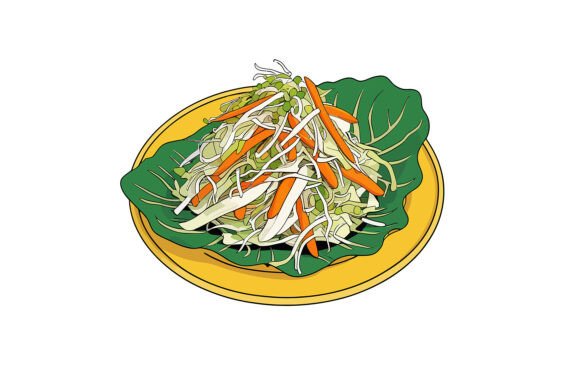
In the realm of graphic design, food imagery serves as a critical visual anchor, capable of evoking appetite, health, and lifestyle in an instant. An Illustration of a Delicious Salad is more than a simple depiction of greens; it is a structured digital asset designed to communicate freshness and vitality across various media. Unlike a photograph, which captures a specific moment in time with fixed lighting and composition, a vector illustration offers a stylized interpretation that can be adapted to fit diverse brand identities. This distinction is vital for designers who require flexibility without compromising on visual fidelity.
The specific asset described here represents a hybrid approach to modern design production. It combines the creative spontaneity of AI-generated concepts with the precision of manual vectorization. The result is a high-quality EPS file that remains fully editable, alongside a ready-to-use JPEG version. Understanding the mechanics of this format helps professionals determine if this resource aligns with their workflow or if alternative approaches might serve them better.
Defining the Asset: What Makes This Illustration Distinct
An Illustration of a Delicious Salad in vector format differs fundamentally from raster-based images or stock photography. The core distinction lies in its mathematical construction. Because the image is built using paths, points, and curves rather than pixels, it possesses infinite scalability. You can resize this salad illustration to fit a small sticker or a massive billboard without encountering the pixelation or blurring common in raster formats like standard JPEGs or PNGs.
This particular asset stands out due to its dual-format delivery. The inclusion of an EPS (Encapsulated PostScript) file ensures maximum flexibility for professional design work. In software such as Adobe Illustrator or CorelDRAW, every element—the lettuce leaves, the tomatoes, the dressing, or the bowl itself—can be isolated, recolored, or reshaped. This level of customization allows a designer to adjust the color palette to match a specific brand's guidelines or to modify the composition for a unique layout.
Conversely, the included high-resolution JPEG file provides a practical solution for projects where editing capabilities are unnecessary. For quick-turnaround tasks, social media posts, or presentations where the image needs to be inserted immediately without opening vector software, the JPEG serves as a reliable fallback. This combination addresses two distinct user needs within a single package, offering both depth for complex projects and speed for simpler ones.
Comparing Vector Illustrations to Stock Photography
When evaluating resources for food-related content, the primary decision often lies between choosing a vector illustration and a stock photograph. Each option carries inherent strengths and tradeoffs that depend heavily on the project's end goal.
Stock Photography excels in realism. If the objective is to showcase a specific menu item with photographic accuracy, a photo is generally superior. It captures texture, light reflection, and the organic imperfections of real food. However, photos come with limitations. They are difficult to integrate into flat-design layouts, they cannot be easily recolored to match a brand scheme, and licensing restrictions can sometimes limit commercial usage, particularly for print-on-demand merchandise.
In contrast, an Illustration of a Delicious Salad offers stylistic versatility. It fits seamlessly into branding materials, logos, and packaging where a cohesive look is required. The ability to change colors means the same base artwork can be used for a summer campaign with bright greens and reds, then adapted for a winter theme with cooler tones. Furthermore, illustrations often convey a sense of playfulness or modernity that stiff, over-processed photos may lack. While a photo shows what the food looks like, an illustration suggests how the food feels—fresh, healthy, and energetic.
However, the tradeoff is that vector art requires a certain level of design skill to utilize effectively. A poorly integrated illustration can look flat or disconnected from the surrounding elements. Additionally, if hyper-realism is the primary requirement, a vector illustration, no matter how detailed, will never fully replicate the sensory depth of a high-end food photograph.
Evaluating the Role of AI-Assisted Creation
A notable aspect of this specific resource is its origin. It was created using AI-generated concepts that were subsequently fully vectorized and edited by a human designer. This process represents a middle ground in the current design landscape. Pure AI generation often results in files that are raster-based, low-resolution, or difficult to edit because the layers are not logically separated. On the other hand, traditional hand-drawn vector art can be time-consuming and expensive.
The "AI-assisted then manually refined" approach leverages the speed of generative tools for concept creation while ensuring the final output meets professional standards through human intervention. The resulting EPS file retains the clean lines and editable paths necessary for professional use, avoiding the jagged edges or tangled nodes often found in raw AI outputs. For buyers, this means receiving a file that is ready for production, rather than a rough draft that requires significant cleanup.
Best-Fit Situations and Practical Applications
Determining when an Illustration of a Delicious Salad is the right choice involves analyzing the intended medium and the desired aesthetic. This asset is particularly well-suited for scenarios requiring scalability and customization.
- Print-on-Demand Products: For t-shirts, mugs, and tote bags, vector files are essential. They ensure crisp edges at any size and allow for color adjustments to suit different garment backgrounds. The durability of vector graphics makes them ideal for screen printing and DTG (Direct to Garment) processes.
- Branding and Logos: Restaurants, juice bars, and health food startups often need iconography that represents their core offerings. A stylized salad illustration can serve as a logo mark or a supporting graphic in a brand kit, maintaining consistency across business cards, signage, and digital platforms.
- Apparel Merchandise: Similar to print-on-demand, custom apparel benefits from the ability to resize graphics without quality loss. The editable nature of the EPS file allows designers to create variations for different collections.
- Web Graphics and Digital Marketing: While web design often uses raster images, vector SVGs (derived from EPS) offer faster loading times and sharp rendering on high-density screens. The JPEG included is also useful for immediate blog headers or social media banners.
- Crafting and DIY Projects: Hobbyists engaged in scrapbooking, card making, or invitation design appreciate the ability to print high-resolution images that do not degrade when cut or resized.
Conversely, there are situations where this asset may not be the optimal choice. If a project requires a photorealistic representation of a specific dish for a restaurant menu where customers expect to see exactly what they will receive, a photograph is likely a better fit. Similarly, if the design workflow relies exclusively on non-vector software like basic word processors or simple image editors that cannot open EPS files, the included JPEG would be the only usable component, limiting the potential for customization.
Decision Factors: Weighing Flexibility Against Cost
When comparing this resource to alternatives, cost and time are significant factors. Commissioning a custom vector illustration from a freelance artist can be costly and time-intensive, often taking days or weeks to complete. Purchasing a pre-made, high-quality asset like this Illustration of a Delicious Salad offers an immediate solution at a fraction of the cost.
However, readers should consider the uniqueness factor. While the design is original and carefully edited, it is a pre-existing asset. If a brand requires a completely unique visual identity that no one else can possibly use, commissioning a bespoke piece might be necessary. Yet, for most general marketing materials, educational resources, or merchandise, the balance of cost, quality, and editability provided by this vector file offers a compelling value proposition.
Another consideration is the technical barrier. Utilizing the full potential of the EPS file requires access to vector editing software. Designers must be comfortable navigating layers, paths, and color swatches. For those without these skills, the JPEG file provides a functional alternative, though it sacrifices the ability to tweak the design. It is crucial to assess whether the project demands deep customization or simply a high-quality visual element.
Conclusion: Making an Informed Choice
An Illustration of a Delicious Salad in vector format represents a versatile tool for modern creators. Its strength lies in the balance between artistic style and technical utility. By offering both an editable EPS file and a ready-to-use JPEG, it caters to a wide range of workflows, from professional branding agencies to individual crafters.
While it does not replace the need for photography in contexts demanding absolute realism, it excels in areas requiring adaptability, scalability, and stylistic cohesion. Whether used for print-on-demand merchandise, digital scrapbooking, or corporate branding, this type of asset empowers designers to maintain high visual standards without the constraints of fixed resolution or rigid composition. Ultimately, the decision to use this illustration depends on the specific requirements of the project, but for those seeking a blend of creativity and technical flexibility, it presents a robust and practical solution.